

New Blood Biomarkers to Advance More Precise Medicine in Respiratory Diseases
Two studies led by researchers from IRBLleida’s Clinical and Molecular Phenotyping (CMP) research group identify new tools to improve risk prediction in COVID-19 patients and strengthen the reliability of RNA-based biomarkers
Researchers from the Clinical and Molecular Phenotyping (CMP) research group at the Biomedical Research Institute of Lleida (IRBLleida) and the University of Lleida have recently published two studies representing a step forward in the development of blood biomarkers for precision medicine in respiratory diseases. Led by the research group of David de Gonzalo Calvo, these studies provide new tools both for predicting the clinical evolution of patients with COVID-19 and for improving the reliability of studies analysing regulatory molecules present in blood.
The first study, published in the journal iScience, explores the potential of circulating microRNAs to improve prognostic prediction in elderly patients hospitalized with COVID-19. Researchers analysed samples and clinical data from 763 hospitalized COVID-19 patients aged over 65 years. The study combined clinical and molecular data to identify different patient subphenotypes and demonstrated that the prognostic value of biomarkers may depend on the characteristics of each group.
The team identified three distinct clinical patient subtypes and showed that a specific microRNA, miR-106b-3p, could help predict 90-day mortality in one of the groups with the highest burden of comorbidities. Incorporating this biomarker into clinical models improved predictive performance compared to models based solely on routine clinical data.
"These findings reinforce the idea that molecular biomarkers can complement traditional clinical information and contribute to more accurate risk stratification in particularly vulnerable populations," explained Manel Pérez Pons, first author of the article and researcher at IRBLleida.
At the same time, a second study published in Biomarker Research addressed a key challenge in biomarker research: ensuring that molecular measurements are reliable and comparable across patients. The team analysed the expression of dozens of long non-coding RNAs in blood samples from 182 individuals to identify a molecule that could serve as a stable internal control for experimental analyses.
The results identified TUG1 as a potential stable endogenous reference gene. This finding may help improve the reproducibility and comparability of future studies investigating long non-coding RNAs as blood-based biomarkers.
"Having a robust reference is essential to ensure that detected biomarkers reflect genuine biological changes rather than technical variations in laboratory procedures," said Carlos Rodríguez Muñoz, first author of the article and researcher at IRBLleida.
"Both studies highlight the potential of non-coding RNA molecules present in blood as tools to better understand patients' health status and advance toward more personalised medicine. While one study provides new prognostic biomarkers, the other establishes a solid methodological foundation to ensure that such discoveries become increasingly reliable and reproducible," noted David de Gonzalo Calvo, head of the research group.
Both projects were driven by the CMP group in collaboration with researchers from the Translational research in respiratory medicine group, as well as healthcare professionals and researchers affiliated with the Arnau de Vilanova and Santa Maria University Hospitals in Lleida, and researchers from the Biomedical Research Institute of Salamanca (IBSAL).
This research was funded by the Carlos III Health Institute (ISCIII) and co-funded by the European Union. The studies also received support from La Marató de TV3 Foundation, Eugenio Rodríguez Pascual Foundation, the Gilead Fellowship Programme for Biomedical Research, CIBERES, UNESPA, SEPAR, AGAUR, and the European Social Fund Plus (ESF+).
Articles:
Perez-Pons M, Benítez ID, Molinero M, García-Hidalgo MC, Rodríguez-Muñoz C, Sanchez-Rodriguez M, Belmonte T, Rogel Vilanova M, Nogales Moreno P, Puente Moreno M, Balaña Prim E, Comella T, Pérez-Sainz A, Cuadrat I, Utrillo-Montagut L, Nicolas-Sánchez F, Moncusí-Moix A, Gort-Paniello C, Postigo T, Ortega A, González J, Barbé F, Bermejo-Martin JF, Torres G, de Gonzalo-Calvo D. Integration of the circulating miRNome and clinical information to predict 90-day mortality in elderly COVID-19 subphenotypes. iScience. 2026 Aug 10;29(8):116951. doi: 10.1016/j.isci.2026.116951. PMID: 42621121; PMCID: PMC13486767.
Rodríguez-Muñoz C, Vila A, Santisteve S, Sánchez-Cucó A, Benítez ID, García-Hidalgo MC, Molinero M, Perez-Pons M, Moncusí-Moix A, Barbé F, González J, de Gonzalo-Calvo D. TUG1: a potential endogenous reference gene for long noncoding RNA quantification in blood-based studies. Biomark Res. 2025 Dec 30;13(1):161. doi: 10.1186/s40364-025-00871-2. PMID: 41469728; PMCID: PMC12754918.
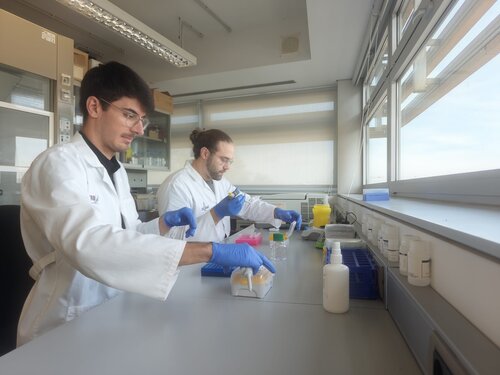
The researchers Manel Pérez Pons y Carlos Rodriguez Muñoz at the IRBLleida laboratory

