

A study from Lleida identifies mechanisms that allow the detection of Alzheimer's risk in people with schizophrenia
The research lays the groundwork for the future validation of a blood test aimed at estimating this risk of dementia
A study led by the +Pec Proteomics group at the Lleida Biomedical Research Institute (IRBLleida) and the University of Lleida (UdL) has taken a decisive step forward in understanding the relationship between schizophrenia and the development of age-related dementias, such as Alzheimer's disease. The research identifies common neuropathological mechanisms between schizophrenia and Alzheimer's disease, related to neuronal connectivity, synapses, inflammation and brain metabolism. The research, carried out in collaboration with Newcastle University and teams from CIBERSAM-University of the Basque Country, has just been published in the journal Acta Neuropathologica Communications.
'Although epidemiological studies have been indicating for decades that people with schizophrenia have a two to three times higher risk of developing dementia in old age, until now the common molecular mechanisms explaining this vulnerability had not been described,' explains one of the leaders of the +Pec Proteomics, Xavier Gallart-Palau.
These common alterations are found in the brain's extracellular vesicles (EVs), small natural structures that transport proteins between cells and reflect the molecular state of the brain.
The study concludes that these vesicles contain key proteins that are altered identically in both schizophrenia and the early and advanced stages of Alzheimer's dementia, revealing a previously unknown biological connection. Furthermore, it has been confirmed that these proteins can circulate in the blood encapsulated in plasma vesicles, opening the door to a new generation of non-invasive biomarkers based on EVs.
'The study lays the groundwork for the future validation of a blood test to estimate the risk of dementia in people with schizophrenia,' added Aida Serra, the other head of the +Pec Proteomics group and professor at the University of Lleida. 'The identification of common mechanisms between schizophrenia and Alzheimer's opens up new lines of research into the relationship between severe psychiatric disorders and neurodegeneration,' she added.
Thanks to a very large clinical validation cohort, the research shows that it is possible to stratify people with schizophrenia according to their risk of developing dementia, using only a blood sample. 'Approximately 20% of people with schizophrenia have a high-risk molecular profile similar to that observed in patients with dementia, which would allow for preventive intervention long before the onset of clinical symptoms,' said Gallart-Palau.
The study also identifies new, highly specific circulating peptide signatures, which reinforce the diagnostic and prognostic potential of these findings.
The findings have been protected by a European patent, with the aim of facilitating their transfer and potential development into clinical applications.
The study was led by the heads of the +Pec Proteomics research group, Xavier Gallart-Palau and Aida Serra, and by the group's early-career researchers, Jose Antonio Sánchez and Maria Mulet, with the participation of researchers from IRBLleida and the UdL. Researchers from CIBERSAM-University of the Basque Country, Newcastle University (United Kingdom) and the Basque Institute of Forensic Medicine also collaborated.
The project was funded by the Carlos III Health Institute, the Ministry of Science and Innovation, the Provincial Council of Lleida, AGAUR, the Generalitat of Catalonia and NextGenerationEU funds.
Article: Sánchez Milán JA, Mulet M, Molet I, Lisa-Molina J, Font-Alberich M, Lorca C, Gea-Sánchez M, Bellon F, Batalla I, Meana JJ, Callado LF, Morentin B, Ramos-Miguel A, Kalaria RN, Serra A, Gallart-Palau X. Brain and circulating EV proteome signatures in schizophrenia as prognostic markers for age-related dementia. Acta Neuropathol Commun. 2026 Jan 20. doi: 10.1186/s40478-026-02223-z. Epub ahead of print. PMID: 41559842.
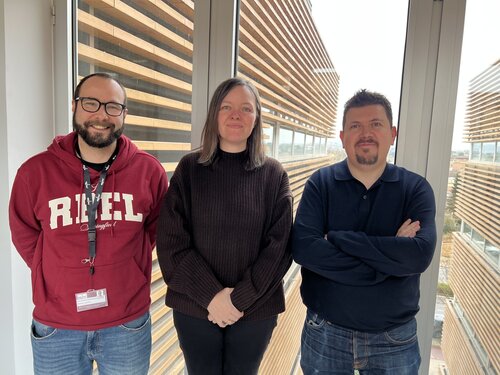
The researchers Jose Antonio Sánchez Millán, Aida Serra and Xavier Gallart-Palau

