


IRBLleida and the University of Lleida are taking part in a clinical trial of a new exoskeleton for people with spinal cord injuries
La investigadora Marta Trapero avaluarà l’eficiència econòmica d’aquesta tecnologia aplicada a les primeres fases de la rehabilitació
The Lleida Institute for Biomedical Research (IRBLleida) and the University of Lleida (UdL) are taking part in a clinical trial investigating the potential of a new robotic exoskeleton for the rehabilitation of people with acute or subacute traumatic spinal cord injuries. Marta Trapero, a researcher at the UdL and the Healthcare Research Group (GReCS) at IRBLleida, will be responsible for assessing the cost-effectiveness of this technology, both from the perspective of patients and their families and that of the healthcare system as a whole.
The study, led by Vall de Hebrón University Hospital and the Vall de Hebrón Research Institute (VHIR), also involves the National Hospital for Paraplegics in Toledo. For the first time, a clinical trial is exploring the potential of this technology in the early stages of the injury, up to six months after the accident, whilst patients are still in the process of recovery.
The research team will use the ABLE robotic exoskeleton, developed by Able Human Motion, a company spun off from the Polytechnic University of Catalonia (UPC). It is a hip-and-knee device with adjustable sizing for neurorehabilitation, designed for the rehabilitation of gait in people with spinal cord injuries at levels C5 to L5.
Rehabilitation tools used in hospitals within the public health system have evolved slowly over recent decades. Conventional treatment relies on devices such as parallel bars, walking hoists, standing frames and splints. The ABLE exoskeleton combines an artificial intelligence programme with bio-inspired adaptive controls that allow the level of assistance to be tailored to each individual's needs.
The study is currently in the recruitment phase and has, so far, enrolled around fifteen patients. As part of the trial, Marta Trapero, a researcher at IRBLleida and the UdL, will analyse the costs and outcomes associated with incorporating the exoskeleton into rehabilitation. This evaluation will assess cost-effectiveness and provide information on the potential impact of the technology on patients, families and the healthcare system.
Text adapted from information provided by UdL Press and VHIR Communications
More information: Vall de Hebrón news
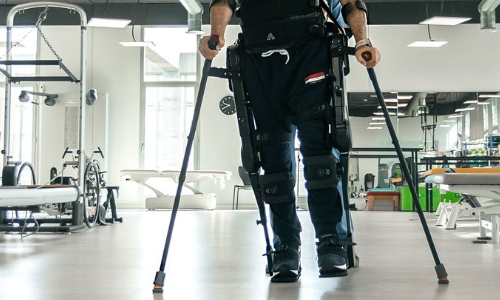
A patient using the device / Photo: Able Human Motion

