


New computer-based tool for studying biodiversity
Developed by staff at the UdL and the IRBLleida as open-source software, it provides a common framework for data analysis
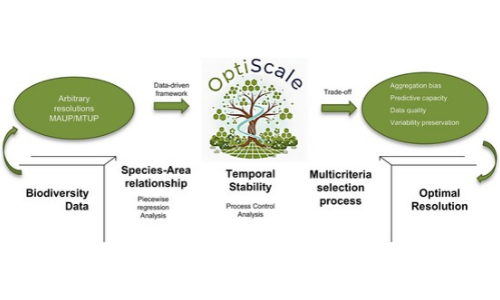
Establishing a common framework for studying biodiversity by processing data in a standardised manner within the current context of climate change is the aim of a new computational tool developed by researchers at the University of Lleida (UdL) and the Lleida Institute for Biomedical Research (IRBLleida). OptiScale, an open-source tool, enhances analysis by helping to determine how data should be grouped in space and time. Staff from the University of Zaragoza and Argentina's National Institute of Agricultural Technology (INTA) also contributed to the study, which was published in the journal Ecological Informatics.
"The conclusions of a study on biodiversity may vary depending on the size of the areas analysed and the time periods chosen. These decisions are often made by convention or on the basis of ad hoc criteria, but they can introduce bias, obscure patterns or make it difficult to compare different studies", explains Rui Alves, Professor of Bioinformatics, Computational Systems and Synthetic Biology at the UdL and head of the Systems Biology and Statistical Methods for Research group at IRBLleida.
OptiScale replaces arbitrary resolution choices with a multi-criteria procedure for selecting scales in a systematic and reproducible manner. The method has been evaluated in three very different regions: the Ebro basin, the Espinal in Argentina and south-western Australia. The results show that the most appropriate scale depends on the characteristics of each dataset.
Overall, the tool provides a standardised approach to comparing and selecting spatio-temporal configurations, whilst maintaining flexibility for different datasets and research questions.
'To study biodiversity properly, it is not enough simply to have a lot of information; you also need to know how to group the data so that the way it is analysed does not distort the results,' Alves emphasises. 'This is particularly important at a time of pronounced climate change, as it enables us to monitor the impacts on biodiversity over time in an objective and systematic manner,' he adds.
This framework makes it easier to compare and replicate ecological studies. Furthermore, the tool's code and documentation are publicly available, which also enables other research teams to use it and adapt it to their own data. "The framework is scalable, adaptable to various datasets and transferable beyond plant biodiversity to any set of georeferenced biodiversity data," notes the UdL professor.
Article: Martinez, E. S., Tejada-Gutiérrez, E., Calcaterra, M., Eleiwa, A., Mateo-Fornes, J., Solsona, F., Sorribas, A., Marin-Sanguino, A., Asín, J., Vilaprinyo, E., Defacio, R., & Alves, R. (2026). OptiScale: A data-driven framework for selecting spatial and temporal resolution in biodiversity analysis. Ecological Informatics, 99, 104084. https://doi.org/10.1016/j.ecoinf.2026.104084
Text: Press UdL
New computer-based tool

