

A study using a glioma model in fruit flies identifies a new potential therapeutic target against glioblastoma
The research focuses on a protein called "Slowpoke" that promotes communication between neurons and the tumour
Researchers at the Lleida Biomedical Research Institute (IRBLleida) and the University of Lleida (UdL) have developed a glioma model in fruit flies that allows them to study how communication between neurons and tumours influences the growth of brain cancer. The study, published in the journal Scientific Reports, identifies an ion channel (a channel that promotes calcium-dependent signalling) called Slowpoke as a possible therapeutic target for slowing down this type of tumour.
Gliomas, also known as glioblastomas in their most aggressive forms, are brain tumours that can exploit neuronal activity to grow and spread. Understanding how this interaction between neurons and tumour cells occurs is key to developing new therapeutic strategies.
To investigate this, the team used the fruit fly (Drosophila melanogaster) as an experimental model. Although mice are the most commonly used animal model in cancer research, Drosophila offers significant advantages, such as lower cost, fewer ethical limitations, and a wide availability of genetic tools. In addition, this insect shares approximately 70% of its genes with humans and has less redundant protein families, which makes it easier to study the specific function of each protein.
Researcher Lía Alza, from IRBLleida and the University of Lleida, led the study under the direction of Carles Cantí and Judit Herreros, professors at the University of Lleida and heads of the Calcium cellular signalling research group. the head of the Drosophila disease models and (epi)genetic analysis, Andreu Casali, and researcher Sergio Casas-Tinto from the Carlos III Health Institute, who had previously used the same model. In their work, the researchers generated gliomas in Drosophila to analyse the role of certain ion channels involved in cell communication.
The results show that these channels contribute to tumour growth and proliferation through calcium ion-dependent signalling mechanisms. Notably, the elimination of the Slowpoke channel in the fly-a channel equivalent to the human KCNMA1 channel-significantly improves the survival of individuals with tumours. Therefore, studying Slowpoke in the fly allows us to understand what role KCNMA1 might play in human brain tumours, such as gliomas.
"The analyses indicate that Slowpoke activity is associated with tumours that have a greater connection with the neurons in their environment. Therefore, its inhibition could reduce the tumour's ability to harness neuronal activity to fuel its growth,' explained researcher Judit Herreros. 'These results reinforce the idea that brain tumours use neuronal communication to progress and support the growing interest in developing drugs capable of disrupting this interaction," added researcher Carles Cantí.
The study was funded by the Ministry of Science, Innovation and Universities and the Fundació la Marató de TV3.
Article: Alza, L., Montes-Labrador, P., Megías, D. et al. Pro-tumoral Ca2+ signaling is dependent on Slowpoke and Ca-α1T channels in Drosophila melanogaster glioma. Sci Rep (2026). https://doi.org/10.1038/s41598-026-42712-8
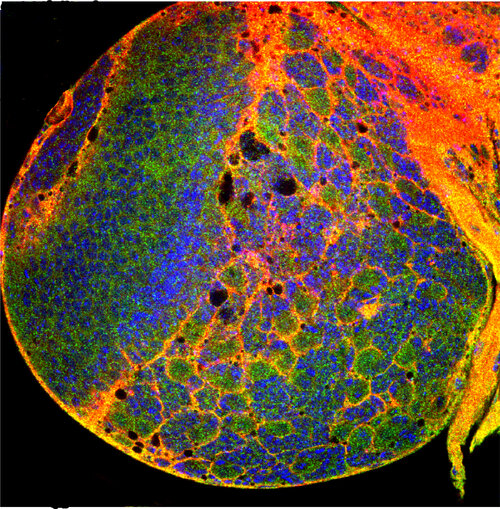
Researchers at IRBLleida and the University of Lleida have developed a glioma model in fruit flies, which can be seen in the image. Photo: Lía Alza

