

Agrotecnio and IRBLleida launch three new projects to bridge agri-food research and biomedicine
They will study the cultivation of luffa to protect the brain; supplementation to improve the quality of calf milk; and the effect of certain chemicals on the food chain.
Agrotecnio and IRBLleida are joining forces once again to drive forward three new research projects through the third joint Agrohealth 2026 call for proposals, which focuses on Agriculture, Food, Nutrition and Health. In this round, projects have been selected that will address the cultivation of luffa to protect the brain; supplementation to improve milk quality and calf physiology; and the effect of endocrine disruptors on the microbiome and the food chain.
This pioneering initiative in Catalonia supports collaborative projects funded with the centres' own resources, bringing together agri-food and biomedical research to advance health and well-being.
Agrohealth is an innovative initiative within the framework of the Network of Research Centres of Catalonia (CERCA), through which Agrotecnio and the Lleida Institute for Biomedical Research (IRBLleida) combine their research capabilities to develop collaborative projects that bring together the agri-food and biomedical sectors with a view to improving health and well-being. This joint effort is in line with the guidelines of the World Health Organisation (WHO), which maintains that cooperation between the health and agricultural sectors is key to ensuring coherent policies and a supply of safe and nutritious food, thereby promoting more sustainable economies and communities.
The 2026 call is the third, following the success of the 2024 and 2022 calls, each of which funded three collaborative projects. As in previous editions, it has a total budget of €135,000, provided by the centres themselves.
"Agroprotect: Agronomic optimisation of luffa for the production of cysteine-rich peptide extracts with neuroprotective properties" is an initiative led by researchers Aritz Royo Esnal (Agrotecnio-UdL) and Xavier Gallart Palau (IRBLleida-UdL). The project aims to make use of luffa, a plant commonly used as a natural sponge, to extract molecules with potential neuroprotective properties. The project's hypothesis is that adjusting irrigation and fertilisation can increase the production of cysteine-rich peptides, bioactive compounds that could help protect cells in the neurovascular system and promote healthier ageing.
Researchers Beatriz Serrano Pérez (Agrotecnio-UdL) and Marina Laplana Lafaja (IRBLleida-UdL) are leading the project "Milk, microRNAs and hydroxytyrosol supplementation in beef cattle: implications for milk quality, calf physiology and One Health". This project studies how administering hydroxytyrosol -a natural antioxidant derived from agricultural by-products, such as olive oil mill wastewater- to cows can modify the microRNAs in their milk. These small molecules regulate gene expression and can influence physiological processes, potentially improving animal health and the quality of derived food products.
The third project funded by Agrohealth 2026 is "From soil to plant to gut: how endocrine disruptors alter the microbiome along the food chain", led by Giada Centenaro (Agrotecnio-UdL) and José Carlos Serrano Casasola (IRBLleida-UdL). This project will investigate how chronic exposure to endocrine disruptors (certain chemicals that can interfere with the normal functioning of hormones and affect health), such as bisphenol A (BPA), may gradually alter the microorganisms living in the soil and the rhizosphere, making it easier for plants to absorb these pollutants and, via food, for them to enter the human body, where they could feed the gut microbiome and affect health, particularly female reproductive health
Each project is funded with €45,000 and will run for two years. Each project, which must address unmet medical needs, involves one research group from Agrotecnio and another from IRBLleida, with the aim of maintaining the collaboration after the project has been completed. Agrohealth is launched every two years and seeks to create lasting synergies between researchers from both centres, so that the projects supported through the initiative can serve as seeds for more ambitious national or international funding calls.
Text: Agrotecnio & IRBLleida
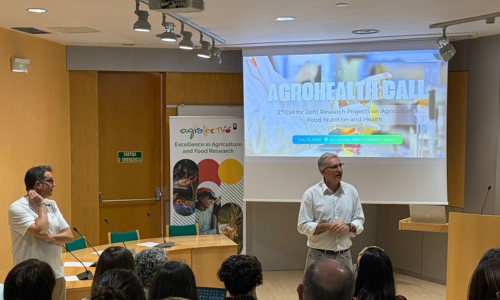
The director of Agrotecnio, José Antonio Bonet Lledós, alongside the director of IRBLleida, Diego Arango Del Corro, at the information session on the Agrohealth Call 2026

