

The Alt Pirineu and Aran Health Region Inquiry Committee is established
Initiated by the Catalan Health Service, it comprises members from healthcare providers across the region, the IRBLleida and the Faculty of Nursing and Physiotherapy at the University of Lleida, and aims to promote health research and knowledge trans
The Alt Pirineu and Aran Health Region has recently set up the Regional Research Commission with the aim of promoting and consolidating research amongst professionals, aligning it with the region's needs. The Commission was unveiled during the 1st Research Conference of the health region, which took place in Tremp and was attended by around sixty people, and which served to raise the profile of and connect research activity across the Alt Pirineu and Aran districts.
The Research Commission comprises representatives from the health region, various healthcare providers in the area, the IRBLleida and the Faculty of Nursing and Physiotherapy at the University of Lleida (UdL), which has had a teaching unit in the region since last academic year. The mission of this body is to facilitate, promote and consolidate health research in the Alt Pirineu and Aran Health Region, fostering an accessible and collaborative research ecosystem, and encouraging the generation of knowledge that has a direct impact on the health of the population.
One of the first initiatives launched by the Commission was today's event, at which two short presentations were awarded prizes in order to recognise local talent and encourage collaboration. The award for best Master's dissertation went to "Evaluation of a training programme in clinical ultrasound for palliative care doctors using the commitment to change strategy", by Rosa Blasi, a geriatrician specialising in palliative care at Cerdaña Hospital; and the award for best research paper went to "Evaluation of the impact of a nutritional strategy on people at cardiovascular risk using the Apa-*fit web application in rural areas. Randomised controlled trial" by Anna Grau, a PhD student in health at the UdL.
During the event, the Government's regional representative for Alt Pirineu and Aran, Sílvia Romero, emphasised the importance of conducting research in the Pyrenees, both for the professionals driving it forward and for their communities. In this regard, she noted that research brings undeniable benefits, congratulated those who had made the creation of the Commission possible, and encouraged them to "work hand in hand with the institutions, which can provide support, assistance and guidance".
Antoni Plasencia, Director-General for Research and Innovation at the Department of Health, also attended the meeting, which he described as a "unifying force and a step towards the future for the institutions carrying out research in the region, given that research and innovation are a fundamental part of the healthcare system, as today's research is tomorrow's healthcare. "And this," he emphasised, "is a shared effort between institutions, professionals and patients."
In the same vein, Felip Benavent, manager of the Alt Pirineu and Aran Regional Health Board, pointed out that although measures to promote research in the region have been in place for some years now, "this conference is a fine example of what it means to seek synergies between the various institutions. It is no longer an individual initiative, but a joint effort by all the region's research-related institutions; nor is it merely a local initiative, but has become part of the Department of Health's planning."
Diego Arango, director of IRBLleida, described the event as a "symbol of maturity in a region with very interesting characteristics, such as the Pyrenees, which make it necessary to address issues such as rural life and the ageing population through research."
Speaking on behalf of the UdL, Carles Capdevila, deputy to the Vice-Chancellor's representative for the Igualada and Pyrenees campuses, emphasised that "there is no university without research, and the Pyrenees need the university as a vital element of social and territorial cohesion. The creation of the Commission is therefore key, and the next step must be to set up research groups focused on specific objectives."
The 4th edition of the Biomedical Research Projects, High Pyrenees and Aran category, is now open
In line with its aim of promoting biomedical research that is relevant to and adapted to the specific characteristics of the region, IRBLleida - Dr Pifarré Foundation has opened the 4th call for applications for Biomedical Research Projects in the Alt Pirineu and Aran regions, which remains open until 8 October. The grants are aimed at professionals with a background in health and/or healthcare who carry out their main work in the Alt Pirineu and Aran Health Region both before and whilst receiving the grant, regardless of where the rest of the research team is based.
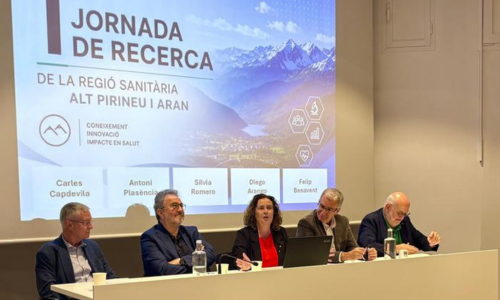
Representatives attending the inaugural table

