


New research combines virtual reality and brain stimulation to improve balance in people with Parkinson’s disease
The pilot study, which involved 23 participants, shows that the intervention is safe, well tolerated and has a high adherence rate
New study combines virtual reality and brain stimulation to improve balance in people with Parkinson's disease
The pilot study, involving 23 participants, shows that the intervention is safe, well tolerated, and associated with high adherence
Gait impairments are among the most common and disabling symptoms of Parkinson's disease. These difficulties often worsen when individuals need to perform two tasks simultaneously, such as holding a conversation while walking, and may persist despite pharmacological treatment.
The Research group of health care (GReCS) at the Institute for Biomedical Research of Lleida (IRBLleida) and the University of Lleida (UdL) has evaluated the effectiveness of, and participant experience with, an innovative rehabilitation programme that combines treadmill training, gamified virtual reality environments, and transcranial direct current stimulation (tDCS), a non-invasive brain stimulation technique. "The results show that the intervention improves balance, and participants reported greater confidence and self-management abilities," explained GReCS researcher Helena Fernández-Lago.
This study provides preliminary evidence of the potential of multimodal interventions that combine physical exercise, cognitive stimulation, and digital technologies to address the motor and cognitive deficits associated with Parkinson's disease. The findings pave the way for future studies involving larger samples to confirm the effects of these strategies and optimise personalised rehabilitation programmes for this population.
The randomised clinical trial, published in the journal Neurological Sciences, compared three intervention approaches: treadmill training alone, treadmill training combined with gamified virtual reality, and treadmill training combined with both gamified virtual reality and tDCS. Participants completed twelve sessions over a six-week period.
"The group that combined virtual reality and brain stimulation showed a specific improvement in gait cadence during motor dual-task situations, a particularly demanding condition for people with Parkinson's disease," added Fernández-Lago.
Beyond the quantitative findings, the study also included interviews with participants to better understand their experiences. Participants reported greater confidence while walking and described adopting strategies to better manage complex mobility situations in their daily lives, such as walking in crowded environments or maintaining stability in the presence of distractions.
The research contributes to expanding knowledge of innovative rehabilitation strategies aimed at improving the quality of life of people living with Parkinson's disease and reinforces interest in approaches that combine physical exercise, cognitive stimulation, and digital technologies. However, the research team emphasises that this is a preliminary study with a relatively small sample size.
The study was funded by the Instituto de Salud Carlos III, with co-funding from the European Regional Development Fund (ERDF) and the European Social Fund (ESF) under the programmes "A Way to Make Europe" and "Investing in Your Future".
Article: Bosch-Barceló, P., Tersa-Miralles, C., Martínez-Navarro, O. et al. A treadmill training program in a gamified virtual reality environment combined with transcranial direct current stimulation in Parkinson's Disease: Preliminary results of a mixed methods randomized controlled trial. Neurol Sci 47, 564 (2026). https://doi.org/10.1007/s10072-026-09136-8
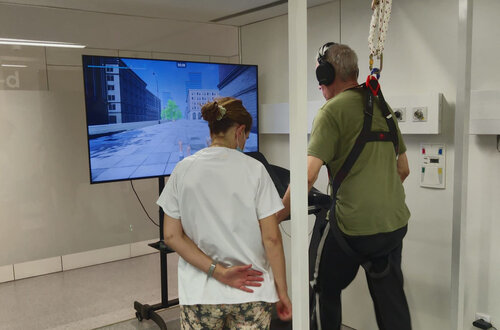
One of the training exercises in the rehearsal involves a treadmill with virtual reality

