


Highlighting the complexity of cancer: the same molecule plays opposing roles in endometrial and colorectal cancer
A research team from IDIBELL and IRBLleida has revealed that the same group of miRNAs acts as a tumour suppressor in colorectal cancer, although in endometrial cancer it promotes tumour progression
The complexity of cancer is undeniable. It is not a single disease, but rather a vast group of conditions, grouped under the umbrella term 'cancer', which are characterised by the development of cells that divide and spread uncontrollably.
This idea becomes even more evident in research such as that carried out by the research group co-led by Dr Xavier Dolcet (IRBLleida-University of Lleida) and Dr David Llobet (IDIBELL). In their two latest studies, they have experimentally confirmed a molecular paradox: the same group of small regulatory molecules, the miR-424(322)~503 cluster, takes on completely opposite roles depending on the type of cancer. Whilst in endometrial cancer it acts as an oncogene, helping the tumour to grow, in colorectal cancer it functions as a brake against the development of the tumour.
The study, recently published in the scientific journal Cell Death & Disease, is the result of close and ongoing collaboration between the Gynaecological Cancer research group at IDIBELL and the Oncogenic Signalling and Development group at the Institute of Biomedical Research in Lleida, as well as staff from CIBERONC (Biomedical Research Network Centre for Cancer). Thanks to these findings, a new avenue has opened up for understanding the onset and progression of colorectal cancer, the fourth most common cancer in men and women, and the third deadliest worldwide.
From the endometrium to colorectal cancer: linking two lines of research
Very often, in the world of biomedical research, a study begins almost by chance or stems directly from previous work. This has been the case with the new study published by IDIBELL and IRBLleida in *Cell Death & Disease*. Whilst the research team was studying how the miR-424(322)~503 cluster promoted endometrial cancer in the context of PTEN gene deficiency, they noticed that the mice in the study which lacked this cluster - and which were therefore theoretically better protected against endometrial cancer - actually had abnormally large intestines.
The team developed an independent cohort to investigate the causes of this finding. From what they could see, mice lacking both the PTEN gene and the miRNA cluster had more precancerous lesions in the colon, which were more complex and larger in volume than those in mice with the intact gene and cluster. They corroborated the statistical quantifications with histological analyses of colon tissue. According to the results, 10% of the mice lacking both PTEN and miRNAs had a normal colon, whilst 90% developed various types of cancerous lesions: low-grade adenomas (50%), high-grade adenomas (20%) or intraepithelial adenocarcinomas (20%).
'The dual loss of the PTEN gene and the miRNA cluster creates an environment that facilitates malignant transformation in the colon, accelerating the rapid progression from polyps to invasive adenocarcinomas,' explains Maria Vidal, the study's lead author and a researcher at IRBLleida and the University of Lleida (UdL). 'This confirms that this miRNA cluster is crucial for controlling and halting the development of colon tumours in the context of PTEN loss, although it has the opposite effect in endometrial cancer,' she adds.
Oncogene or tumour suppressor depending on the context
One of the most intriguing questions that remains is why the same molecule behaves as an oncogene or a tumour suppressor depending on the cellular context. Dolcet and Llobet's team have demonstrated this in two different cancers, using the same experimental model and under identical conditions (loss of the PTEN gene, typical in patients).
"In the endometrium, if we removed this cluster, the tumour grew less. In contrast, in the colon, the exact opposite happens: without it, the lesions multiply and become aggressive,' explains David Llobet, head of the Gynaecological Cancer group at IDIBELL. 'This duality shows us that the function of a miRNA depends entirely on the type of tissue and cellular microenvironment in which it is found, particularly in cancer," he continues.
The team's hypothesis is that, in the colon, the miR-424(322)~503 cluster acts as part of a compensatory tumour-suppressing response. "When PTEN is lost in the colon, the cluster functions as a protective mechanism that helps to curb the excessive activation of other potentially oncogenic pathways that run amok without PTEN," explains Xavier Dolcet, a researcher at IRBLleida. "In such a situation, when the cluster loses its activity, this compensatory brake is removed and excessive signalling is triggered, which stimulates colorectal cancer," he concludes.
Understanding the molecular mechanism by which miR-424(322)~503 functions in colorectal, endometrial or other types of cancer is essential for the design of future precision medicine therapies. It is crucial to tailor these therapies to the specific type of cancer, because strategies that might be beneficial for one type of cancer (such as blocking this cluster in endometrial cancer to slow progression) could be counterproductive in another (if applied to colon cancer, a natural protective mechanism would be lost).
Article: Vidal-Sabanés, M., Bonifaci, N., Navaridas, R. et al. miR-424(322)~503 impairs colon cancer progression driven by PTEN deficiency. Cell Death Dis 17, 254 (2026). https://doi.org/10.1038/s41419-026-08504-8
Text: IDIBELL
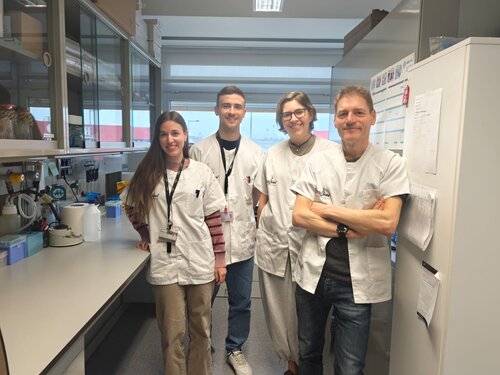
The research team from the Oncogenic and Developmental Signalling Group at IRBLleida

